
November 4, 2025
Large language models excel at summarizing and generating text, but they’re not built to know real-time facts. Ask a standard LLM, “What were yesterday’s revenues?” and it will hit its knowledge cutoff, then confidently invent an answer.
RAG (Retrieval-Augmented Generation) addressed part of this problem by allowing models to pull in external data, thereby improving factual accuracy. But classic RAG still falls short when a request is unclear, requires multiple reasoning steps, or spans several data sources.
Agentic RAG fills that gap. By adding AI agents to the RAG pipeline, the system can break a request into steps, determine which information is needed, select the appropriate source, verify the result, and repeat the process if necessary. It moves from “retrieve + summarize” to “think + decide + act.”
A Quick Recap: How RAG Works — and where it falls short
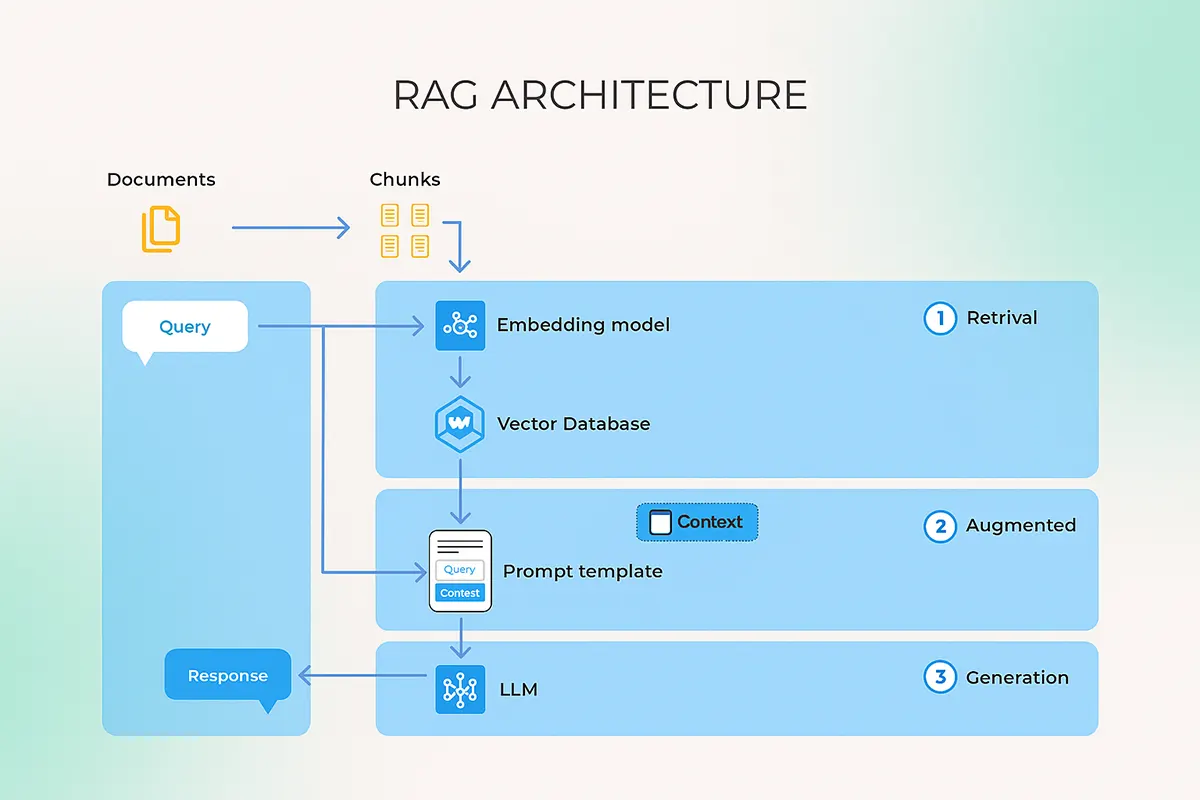
RAG, at its core, is a clever workaround for the fact that language models don’t actually know everything—they only know what they were trained on. With a RAG setup, the model doesn’t rely solely on its internal parameters. Instead, when a user asks a question, the prompt is routed to a retriever that searches external sources—company documents, databases, curated knowledge bases, etc.—and pulls back the most relevant pieces of information.
Those retrieved chunks are then fed into the generator, which blends them with the model’s built-in knowledge to produce a final response that’s both fluent and grounded in real data. In other words, RAG lets the model think with fresh facts, not just frozen training data.
Where Traditional RAG Falls Short
1) Shallow reasoning ability
RAG can retrieve information, but it can’t reconcile it. If the answer requires pulling together multiple facts, resolving contradictions, or interpreting language that doesn’t match the stored data, the model is likely to guess or hallucinate..
2) One-shot retrieval
Traditional RAG does a single lookup and then generates an answer based on whatever it finds. If the retrieved data is incomplete, irrelevant, or outdated, the model won’t notice — it just writes confidently anyway.3) Weak traceability
Citations sound great in theory, but in practice, the model may paraphrase, merge, or drop chunks of retrieved text, making it hard to verify which part of the answer came from where.4) Context window limitations
All retrieved documents must fit into the model’s context window along with the user query. If the content is too long, or too many chunks are retrieved, information gets truncated — meaning important facts can be silently left out.
In short: classic RAG can retrieve, but it can’t truly reason — which is exactly the gap Agentic RAG is designed to fill.
What is Agentic RAG and how does it work?
1. Query understanding – Agents clarify vague prompts, break complex requests into parts, and add context before retrieving anything.
2. Smart retrieval – The system decides which data sources or tools to use (vector DBs, SQL, APIs, web search), ranks and filters results, and combines evidence across sources.
3. Reasoning over results – Retrieved chunks are analyzed, clustered, and conflict-checked instead of being passed raw to the model.
4. Validation – Agents score confidence, verify sources, and trigger additional lookups if the context is insufficient or inconsistent.
5. Controlled generation – The model produces the final answer with structure, traceability, and minimized hallucination—guided by agent logic, not guesswork.
By inserting reasoning and feedback loops into each step, Agentic RAG overcomes the major weaknesses of traditional RAG and makes retrieval-based AI reliable enough for real enterprise use.
Traditional RAG vs. Agentic RAG
| Traditional RAG | Agentic RAG |
|---|---|
| Provides one-way, passive retrieval of knowledge | Uses active, autonomous agents that reason and make decisions |
| Works in a linear, single-step flow (retrieve → answer) | Works in a dynamic, multi-step loop (plan → retrieve → act → verify → answer) |
| LLM depends entirely on retrieved context | LLM can refine queries, re-search, validate, and improve results |
| Limited by what is returned from the vector database | Can use tools, APIs, and iterative thinking to overcome missing info |
| Useful mainly for static question-answering | Suitable for complex tasks, workflows, and multi-action reasoning |
What Agentic RAG Really Brings to the Enterprise Table
wo Ways to Build Agentic RAG Systems
There are two main paths to implementing Agentic RAG in practice: LLM-native function calling and external orchestration frameworks. The right choice depends on how complex your workflow is, how many tools or data sources you need to coordinate, and how much control you want over the reasoning steps.
✅ 1. Function Calling Inside the LLM
Modern models like GPT-4-turbo and GPT-5 can call external functions during generation. This is the simplest, fastest way to enable agent-like behavior because the model decides when to call a tool, runs it, and continues reasoning with the returned data — all in one loop.
Best for:
-
Lightweight use cases
-
Few external tools or data sources
-
Fast response time > complex orchestration
Pros:
-
No heavy orchestration layer required
-
Easy to implement: define functions, let the LLM decide when to use them
-
Faster latency, fewer moving parts
Trade-off:
-
Limited visibility into step-by-step reasoning
-
Harder to customize retrieval logic, validation rules, or multi-agent behavior
✅ 2. Orchestration Frameworks
For large, multi-step, multi-tool, or multi-agent use cases, enterprises often lean on orchestration frameworks. These let you build full workflows with branching logic, shared memory, observability, retries, and parallel tool calls.
| Framework | Strength |
|---|---|
| LangChain / LangGraph | Most mature ecosystem for agent workflows, planning, memory, and tool routing |
| LlamaIndex | Strong RAG-first architecture with flexible retrieval and indexing layers |
| DSPy | Production-ready ReAct-style agent framework with automatic prompt optimization |
| CrewAI / MetaGPT | Multi-agent coordination and task-specific agent templates |
| Swarm (OpenAI) | Experimental but lightweight agent-to-agent architecture |
| IBM watsonx Orchestrate | Enterprise-grade governance, logging, security, and workflow control |
Some teams skip frameworks and write custom orchestration in Python for maximum control. That enables fully customized routing, logging, and retrieval strategies — but requires more engineering effort.
Pros of orchestration frameworks:
-
Full visibility: logs, traces, retries, reasoning graphs
-
Best for multi-agent and multi-tool workflows
-
Easier to scale retrieval, validation, and collaboration logic
Trade-off:
-
More components = more complexity
-
Higher latency than direct function calling
-
Requires infra + devops support
Pro tips from the field for building Agentic RAG systems (so you don’t learn the hard way)
If you’re gearing up to deploy an Agentic RAG system in a real enterprise environment, a few hard-earned lessons can save you time, budget, and headaches. Here are field-tested recommendations from engineers who’ve done it in production: 🔐 1. Treat the data layer as mission-critical, not an afterthought RAG lives or dies on data quality and access control. Secure your databases, lock down credentials, and ensure sensitive data never slips into the wrong context window. A brilliant agent is useless if the data pipeline is weak. 🛠️ 2. Teach agents what your tools can actually do Agents don’t magically “figure out” which tool fits which task. Give them clear descriptions, inputs, outputs, and usage examples. The better the tool schema, the smarter the routing and the fewer bad calls you’ll see. 👀 3. Audit agent decisions regularly Even well-designed agents drift. Spot-check retrieval decisions, tool choices, and reasoning traces. If confidence is low or the logic looks off, trigger a human review or define fallback paths before the system goes rogue. 🧹 4. GIGO still applies — garbage in, garbage out If the knowledge base is messy, outdated, or missing key context, agents will confidently return nonsense. Keep your documents rich in metadata, well-chunked, and updated. Better docs = fewer hallucinations = fewer fire drills. 📊 5. Log everything and monitor aggressively More autonomy means more risk. Track tool calls, retrieval steps, confidence scores, retry loops, and time spent per agent. When something breaks (and it will), observability is the difference between a 5-minute fix and a 3-day outage. 🤏 6. Use as few agents as possible Yes, multi-agent systems look cool on diagrams — but every extra agent adds cost, latency, and potential chaos. Start lean, only add specialization when workload demands it, and don’t let “agent sprawl” become the new microservices problem.Table of Contents
- A Quick Recap: How RAG Works — and where it falls short
- Where Traditional RAG Falls Short
- What is Agentic RAG and how does it work?
- Traditional RAG vs. Agentic RAG
- What Agentic RAG Really Brings to the Enterprise Table
- wo Ways to Build Agentic RAG Systems
- Related Articles
- Why QA Matters: A Simple Story About Shipping Software People Trust
- Vibe Coding for Enterprises: AI Engineers’ Blueprint for Smarter, Emotion-Aware Systems
- Microservices vs Monolith: Which Architecture is Right for Your Project?

Why Trust Techzooni?
Choose Techzooni for Augmented Reality because we bring innovation to life. Our cutting-edge AR solutions transform your business operations, streamline processes, and elevate customer experiences — all while driving efficiency and reducing costs. Experience the future today with Techzooni!
Step into the Future of Health Insurance with Augmented Reality. Faster Claims. Smarter Solutions. Better Service.
Related Articles
Why QA Matters: A Simple Story About Shipping Software People Trust
Meet Sam. Sam leads a small team building a new feature for a food delivery app: “skip-the-line pickups.” The deadline is tight, the demo is next Friday, and everyone’s excited. They code fast, push to staging, click around a bit—looks fine!—and ship. Two hours later,...
Vibe Coding for Enterprises: AI Engineers’ Blueprint for Smarter, Emotion-Aware Systems
Imagine a future where building software feels a bit like having a conversation. You tell your system what you want in plain English. Behind the scenes, intelligent agents spin up code, run tests, refactor, and even suggest improvements. That’s the world of vibe...
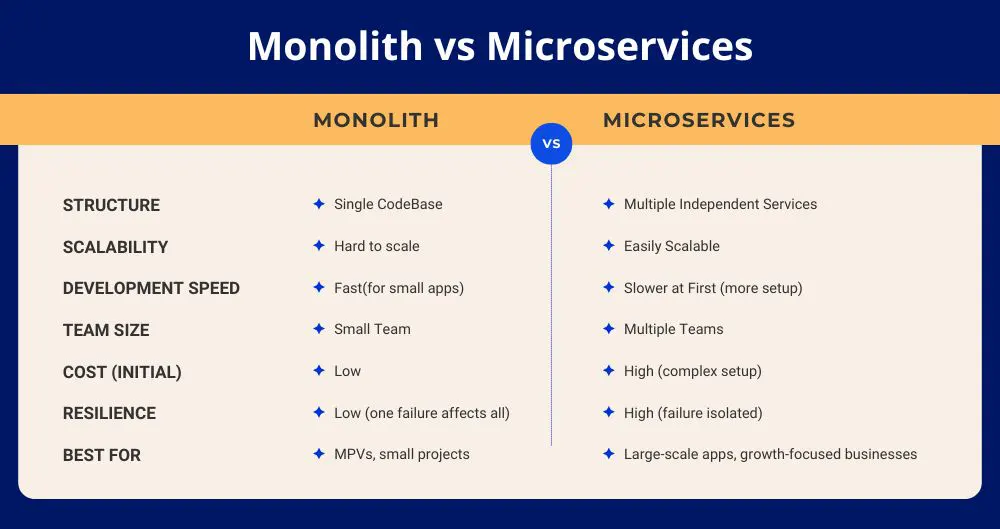
Microservices vs Monolith: Which Architecture is Right for Your Project?
Imagine that you’re opening a new restaurant. You could either rent one big hall where the kitchen, storage, and dining all happen in the same space—or you could design separate sections: a kitchen, a pantry, a dining area, and a drive-thru. Both setups can serve...